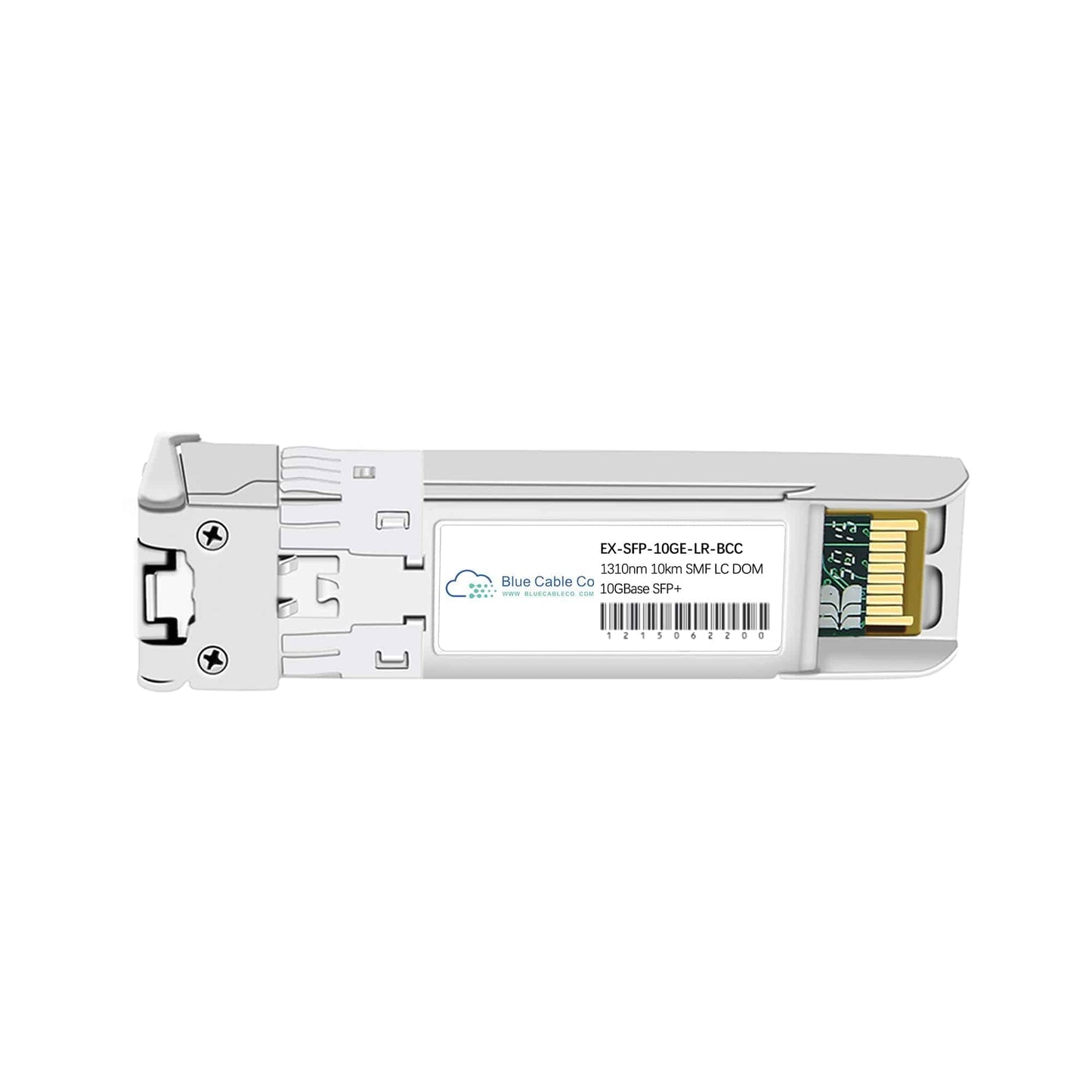
Q: Will this work in place of the Juniper EX-SFP-10GE-LR?
A: Yes. The EX-SFP-10GE-LR-BCC is designed as a direct replacement for the Juniper EX-SFP-10GE-LR. It matches the OEM module in form factor (SFP+), data rate (10 Gbps), standard (10GBASE-LR), wavelength (1310nm), and reach (10km over single-mode fibre). The transceiver is plug-and-play compatible and will be recognised by Junos OS without requiring configuration changes.
Q: Which Juniper platforms support this transceiver?
A: This transceiver is compatible with Juniper EX-Series (including EX2300, EX3300, EX3400, EX4200, EX4300, EX4400), MX-Series routers (MX204, MX240, MX304, MX480, MX960, MX150), QFX-Series data centre switches, ACX-Series (ACX5000, ACX7024, ACX7100, ACX7348, ACX7509), and SRX-Series security platforms. The module works in native SFP+ ports and in QSFP28 ports with a QSA adapter. Confirm port type and Junos OS minimum release requirements for your specific platform.
Q: What fibre type and connector does this transceiver require?
A: This transceiver requires 9/125µm single-mode fibre (SMF) with duplex LC connectors. Both fibres must be terminated and connected: one for transmit at 1310nm, one for receive at 1310nm. Maximum reach is 10km, but actual distance depends on fibre quality, insertion loss, and total link budget. Do not use multi-mode fibre, as the 1310nm wavelength and power levels are optimised for single-mode only.
Q: How do I access the digital optical monitoring (DOM) data?
A: DOM data is accessible through the Junos OS CLI using commands such as 'show interfaces diagnostics optics' for real-time temperature, voltage, transmit bias current, transmit optical power, and receive optical power. The transceiver implements SFF-8472 compliance, exposing these parameters over the I2C management interface. This allows monitoring of optical link health and early detection of degraded transmit or receive levels before link failure occurs.
Q: Can this transceiver operate at speeds lower than 10 Gbps?
A: Yes. The transceiver supports data rates from 1.25 Gbps to 10.31 Gbps, enabling operation in 10 Gigabit Ethernet (10.31 Gbps), Gigabit Ethernet (1.25 Gbps), and STM-64 (9.95 Gbps) applications. The host port must be configured for the desired speed; the transceiver will adapt to the signalling rate presented by the host. This multi-rate capability is useful in migration scenarios where a single optic can serve both 1G and 10G requirements.