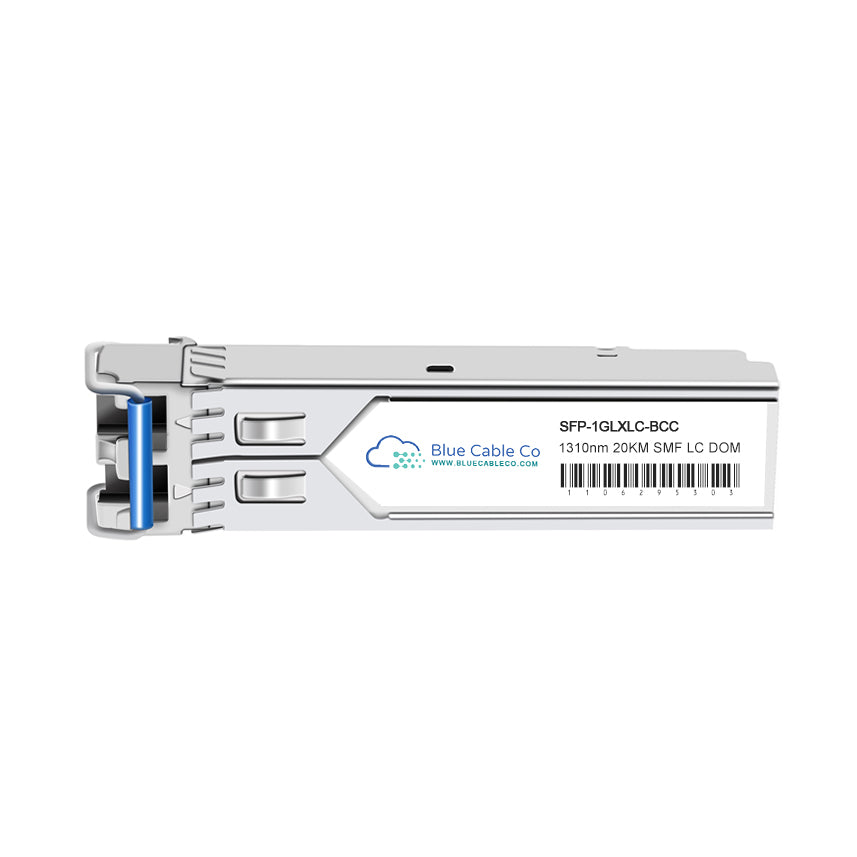
Q: Will this work in place of the Moxa SFP-1GLXLC?
A: Yes. The SFP-1GLXLC-BCC is a direct replacement for the Moxa SFP-1GLXLC. It conforms to the same IEEE 802.3z 1000BASE-LX standard, uses the same SFP form factor, operates at 1.25 Gb/s over single-mode fibre at 1310nm, and delivers the same 10km reach. It is plug-and-play compatible with Moxa switches and routers.
Q: Which Moxa switches and routers support this transceiver?
A: This transceiver is compatible with any Moxa device that accepts SFP modules and supports 1000BASE-LX or Gigabit Ethernet SFP ports. This includes the ICS-G7848/G7850/G7852, ICS-G7748/G7750/G7752, ICS-G7826/G7828 series, IKS-G6524/G6824 series, EDS-G508E/G512E/G516E, EDS-518A series, EDS-510A series, and IM-G7000 interface modules, among others. Consult your Moxa platform datasheet to confirm SFP slot availability.
Q: What type of fibre cable and connector do I need for 10km transmission?
A: You need duplex single-mode fibre cable (OS1 or OS2 grade, ITU-T G.652 compliant) with LC/UPC connectors on both ends. The transceiver uses two fibres: one for transmit (1310nm Tx), one for receive (1310nm Rx). Actual reach depends on fibre quality, splice loss, connector insertion loss, and total link attenuation. A typical link budget of 8 to 10 dB supports 10km over clean, low-loss single-mode fibre.
Q: Can I access Digital Diagnostic Monitoring data on this transceiver?
A: Yes. This transceiver supports DDM (also called DOM) per SFF-8472 MSA. If your Moxa switch or network operating system supports DDM, you can read real-time optical parameters including transmit power, receive power, module temperature, laser bias current, and supply voltage. This data is accessible via CLI, SNMP, or management interface depending on your platform and helps with proactive link health monitoring and troubleshooting.
Q: What happens if I exceed the 10km distance specification?
A: Beyond 10km, the optical power budget may be insufficient, leading to increased bit error rate, intermittent link drops, or complete loss of signal. The transceiver typically provides 8 to 10 dB of link budget. Exceeding 10km requires higher-quality fibre with lower attenuation (e.g., premium OS2), fewer splices, and clean connectors. For distances beyond 10km, consider a 1000BASE-LH or 1000BASE-EX module with higher transmit power and improved receiver sensitivity.