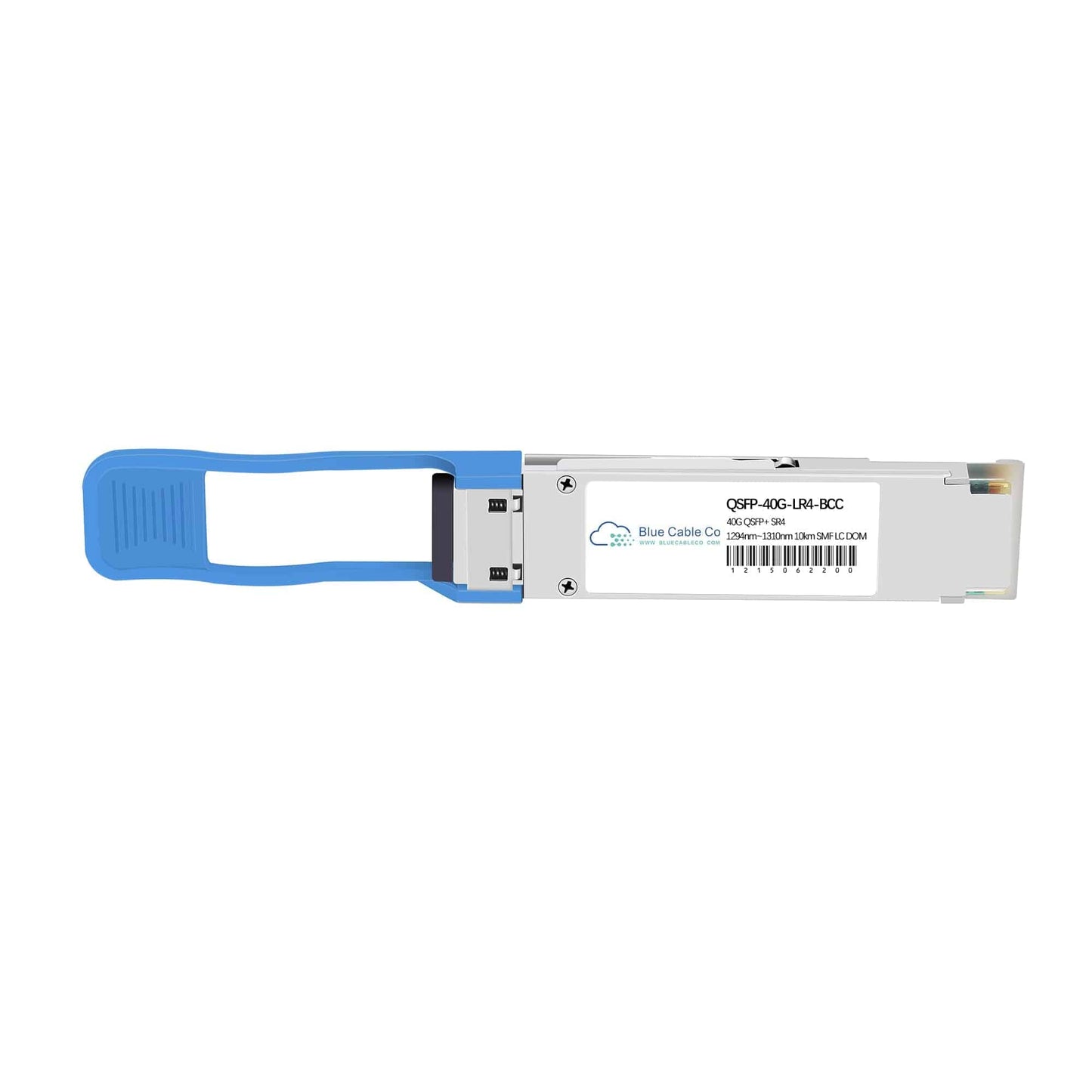
Q: Will this work in place of the Dell 407-BBGN?
A: Yes. The 407-BBGN-BCC is designed as a plug-and-play replacement for the Dell 407-BBGN. It matches the reference part on form factor (QSFP+), data rate (40 Gbps), standard (IEEE 802.3ba 40GBASE-LR4), wavelength (1310nm CWDM), reach (10km SMF), and connector (duplex LC). It will operate identically in Dell Networking equipment.
Q: Which Dell platforms support this transceiver?
A: This module is compatible with Dell platforms featuring QSFP+ ports that support 40GBASE-LR4. Dell documentation confirms compatibility with Force10 MXL blade, S4810, S4820T, S60, Z9000, Z9500, Networking C7004, C7008, C9010, N4032, N4064, S4810-ON, S5000, S6000, S6000-ON, S6010-ON, and EMC Networking S4048-ON switches. Any Dell switch with a 40GbE QSFP+ port and NOS support for LR4 optics will work.
Q: What are the four CWDM wavelengths and why does this matter?
A: The module transmits and receives on four discrete wavelengths: 1271nm, 1291nm, 1311nm, and 1331nm, as defined by ITU-T G694.2. Each wavelength carries 10 Gbps, multiplexed onto a single fibre pair to achieve 40 Gbps aggregate. This CWDM lane architecture allows the use of standard duplex LC single-mode fibre without requiring parallel optics or MPO connectors, simplifying cabling infrastructure for long-reach deployments.
Q: Does this transceiver support digital diagnostics, and what parameters can I monitor?
A: Yes, the module supports DOM (digital diagnostics monitoring) per the QSFP+ MSA specification. You can access real-time optical transmit power, optical receive power, internal temperature, transmit bias current, and supply voltage via the I2C serial interface. These parameters allow you to monitor link health, detect marginal conditions before failure, and verify optical budget compliance across the 10km span.
Q: What is the actual reach on this module, and does fibre type affect distance?
A: The module is specified for up to 10km on single-mode fibre with a minimum optical budget of 9.7 dB. Actual reach depends on fibre loss, splice loss, connector quality, and dispersion. OS2 single-mode fibre is recommended to minimise chromatic dispersion at 1310nm. Using lower-grade fibre or fibre with high loss per kilometre will reduce effective distance. Always calculate link budget based on your installed fibre plant characteristics.